Sunday, June 30, 2013

Uttarakhand catastrophe: The horror, and the new gods

Next
Uttarakhand catastrophe: The horror, and the new gods
 
The chopper crash killing 20 rescuers on board has once again brought the horror of the situation prevailing in the Kedarnath region. Everyone saluted the brave-hearts who laid down their lives in the service of common Indians. They have emerged as the new gods of Kedarnath. The eye of Shiva that protects, not destroys.
Everything that shouldn’t have happened, happened in Uttarakhand.
The monsoon was forecast a fortnight later, yet with the cloudburst the Chauri Bari lake (also known as Gandhi Sarovar) sank into KedarValley burying thousands under the huge boulders and a wall of water that fell on pilgrims from above. That was on June 16.
The first help reached them on the evening of June 19.
The rush of pilgrims should have been a little less in the week closer to the rains, yet it was overwhelmingly crowded and the road to Kedarnath was like a sea of people of all colours, countries, provinces and castes.
As everyone knows, the monsoon often wreaks havoc in this part of the state, so the disaster management team should have been very, very alert, its plans in place and the manpower smartly distributed at all the vulnerable points so that in any eventuality the rescue teams are rushed to the spot without wasting a second.
None of the areas that are vulnerable and known as the most crowded places in peak season, had any disaster relief team stationed and well-equipped, no emergency plans were ever prepared; no disaster control room was even designed to serve professionally in the last one decade.
The district magistrate of the area should have been the first to sound the alert, and to caution pilgrims when the first news of the rains arrived.
But he suddenly had a massive stroke at the most critical moment and was brought to Dehradun for treatment.
In the shadow of a terrific calamity, the state government took five days to appoint a new DM. The most precious time to control and minimise the damage was thus lost.
The incident also proved that in spite of being the place of highest reverence for Hindus, that brings more than 400 million faithful from across the globe every year, the area didn’t have a hospital to provide emergency treatment to people in distress. Even a district magistrate had to be rushed to Dehradun.
Think of the common citizens and pilgrims in such a situation.
The nation, ie, the political masters who take decisions to send help in such situations, and the media, that creates the atmosphere to have an appropriate response by society, should have been completely focused on the incident.
But when the dying people needed urgent response in Kedarnath, politicians and the television channels were busy responding to Nitish-Modi-Advani-RSS issues and  discussing the future of NDA post the JD-U ‘s secular divorce.
Nothing mattered to them as important and as engaging as this political potpourri.
TV Channels relied on their junior-most reporters, sometimes stringers based in the state, they even used Facebook photos as exclusive ‘breaking news’ clips. But a Pakistan election gets their chief editors, principal political editors and the highest-ranking senior analysts to go to Islamabad and report from there.
Plus, the reports from the state were too noisy and haphazardly presented. For Delhi station directors, Kedarnath didn’t deserve a well-planned and top-slotted reporting till the third day was over.
In market-driven stupid shows, the media in Delhi was discussing ‘didn’t I tell you a hundred years before that unless you follow what I have been prescribing such calamities will occur’ and giving a push to ‘green journalism’ in a sordid drama of one-upmanship. And another began a discussion on Rahul-Modi contributions to help Kedarnath victims. They were shameless enough to use a tragedy to earn more masala-driven TRPs.
The TV channels hardly showed any sensitivity to the victims, their relatives and the local residents of Gupt-Kashi, Ukhimath, where almost every home lost a member. Weeping mothers, old men with hardly any energy to speak, wailing families and extreme shows dominated the screen. The print media, on the contrary, was more sincere and sensitive to the situation.

Prev

Next
It all resulted in chaos.
Chaos that prolonged the dark night of death.
Chaos that saw the most excruciatingly painful and torturous five days for the thousands of pilgrims.
And that perhaps increased the toll of the dead to an unimaginable count.
And look at how our people, our citizens and our kith and kin died.
Usha Soni’s husband died in her lap; he had dysentery and no anti-diarrhea medicine was available.
Sohan Lal Vyas from Udaipur saw her son, daughter-in-law, sister’s son and sister getting buried in the water-wall that came with a huge gush of mud and pebbles.
A mother was holding her little baby at Kedarnath, and to make secure that hold she tried to clutch the Nandi idol, but in that fraction of a second the water flow took away the wailing child.
Khushboo Sahay of Varanasi was swept away with her husband and son; she was found two days later on the river bank, unconscious, by army men and revived.
The people on the 14-km long trek to Kedarnath, a huge sea of faithful, vanished into the watery assault that came with unimaginable force and speed, sweeping away vehicles as if they were made of cardboard.
Those who were fortunate to be alive experienced Pralay -- the end of Earth.
A family of eight was washed away with a 10-year-old boy being the lone survivor.
For six days people at Gauri Chatti, Bhairav Ghati, Rambari, Gauri Kund were left to their own devices. No food, no water. All around dead bodies lay scattered. Bodies of dead ponies and scores of other animals turned the area into the most horrendous and frightening one. No one could even airdrop pamphlets with instructions, guidance and hope. No one conveyed to them, ‘We are coming. We shall bring all of you back home safely’.
Porters and pony-wallahs assaulted the women. Pilgrims were taken to wrong, lonely routes to deprive them of their belongings. A porter took 16,000 rupees from a group of 10 from Patna, one of them Narendra Singh, a former chief manager of the State Bank of India, just to show them the correct path to Sonprayag. Fingers of dead bodies were cut to take out golden rings. Their pockets were emptied. An ochre-robed man was found with 80 lakh rupees and promptly arrested.
The aircraft pressed into service to evacuate pilgrims were small, like three- to six-seated choppers. They had a refuelling problem. The director general of police, Uttarakhand, told me and urged for help. I spoke to the prime minister to facilitate the ATF airlifted to higher regions to save time and evacuate more people.
It goes to the credit of our PM that he immediately conveyed this to the cabinet secretary and the needful was done.
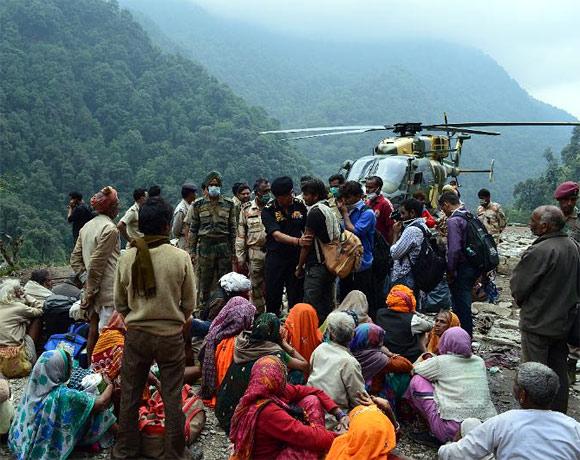
Thousands were stranded in Badrinath, Gangotri and Kedarnath regions. It was only after the death toll rose too high and the national media finally understood the seriousness of the catastrophe, that more choppers were brought in to make more sorties.
June 22 and 23 were hectic for Kedarnath, but thousands of stranded pilgrims at Badrinath were told to wait, as ‘they were safe’. We left Gupt Kashi by road on the 24th morning early, at 4.30 am. Hundreds of rescued pilgrims were with us, in vehicles. Old and young women who have lost sons, daughters, fathers and parents and all family members. The tragic stories were endless. Hardly 45 km later we faced huge landslides.
In the entire 200 km stretch only one JCB road clearance machine was deployed. It was working at its peak speed, but still would have taken a day to clear the huge blockades if an army officer, Col Anil Mehra, had not put into action two other JCBs lying idle in a village as they were ‘privately owned’. That’s the difference between a babu-government and the army man, everyone realised.
A young kid, Shivam Bisht, was crying with pain. He had suffered major knee injury at Kedarnath and a bleeding sore in the stomach. By chance a doctor, which had come to Gupt Kashi from AIIMS to help pilgrims, was with our convoy. He did some first aid. Spoke to state’s health minister Surendra Singh Negi, and he assured that once the boy reaches Dehradun he will be provided all medical help and also special financial assistance.
Prev

Next
The agony that began in Kedarnath was unending.
Have they brought all yatris from Kedarnath? Perhaps not. Some pilgrims were still reported to be in Bhairav Ghati and beyond. With the monsoon beginning, they would be needing immediate help. They might not be having any food, shelter and warm clothes. Who is going to provide all that?
And what about the dead still buried in Kedarnath area? The bodies have begun to decay and stink. Army officers say unless they are cleared in the next two to three days, a massive attack of infections may engulf the entire state.
It’s only on the fourth and the fifth day that some NDRF teams were sent to Guptkashi, Kedarghati, Gauri Kund and Gangotri areas. Doctors’ teams from the Indian Medical Association, AIIMS, Gangaram (New Delhi) too arrived at some places like Guptkashi. But the ordeal of the pilgrims at Gauri Kund, Ram Bari, and Jungle Chatti remained unspeakably painful. No shelter, no tents, out in the open without even a sheet of cloth to cover in that wintry, windy climate. The shopkeepers, lodge-owners, were either dead or gone to safety.
Everywhere it was a spine-chilling reign of fear, bad memories and hopelessness. People were defecating anywhere. Water was down there in the Mandakini river. No one was in a condition to hold the hands of the other. A chopper came but the minister took his two relatives and flew away. More sorties and more chaos. Thousands of stranded people, and a clamour to board and leave the hell. The ‘me-first’ push of the crowd eager to reach a safer zone can’t be described, it can only be felt.
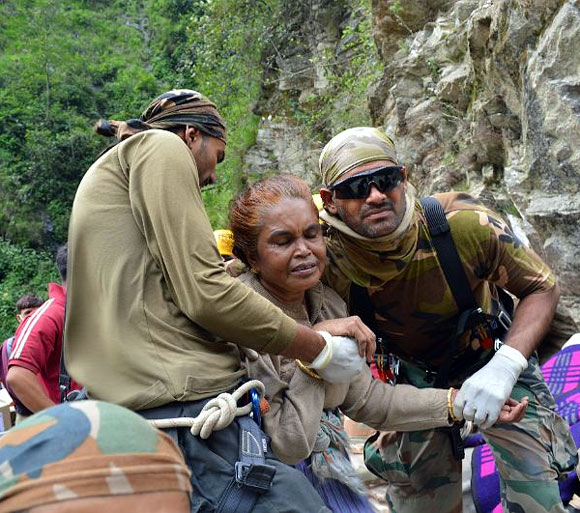
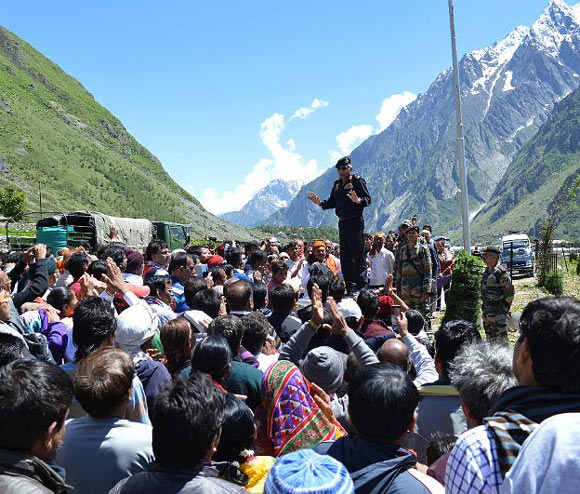
The only gods of succour and life-providing bliss were the men in olive green, the army, the ITBP personnel and the RSS swayamsevaks. Like angels they did everything that was possible in that situation. RSS youngsters were the first to reach Gauri Kund and provide food, water and solace to dejected, fatigued, yatris enveloped in hopelessness. And so were the Gayatri Parivar, local NGOs, the police association, college student unions, etc. It’s a tragedy that driven by hate and an ideological apartheid, the wonderful and selfless contribution of the RSS was completely ignored by the media, though the army men gave them a hug and cooperated with them.
The IAF and army saved thousands of people. Crossing ferocious streams and rivers on a string of wire with old, young and the children clinging to them; like monkey cubs, they dawned on the scene as angels. But too many were to be rescued and too less was the number in proportion to the need and calamity-struck people.
The security personnel manning the air-rescue had to have some rule -- and one was to get the women, aged and ailing onboard first. It divided the families. Men and many times young women of the family were left behind. Seemingly young were asked to trek down up to Sonprayag from Gauri Kund, about 14 to 16 km, passing through a bit of forest and negotiating a high hill. In Gangnani area, seemingly youthful ones had to trek approximately 75 km to reach safety.
Though some said it was forgotten that after a painful stretch of five days, without food, even the young were half-dead. The mental stress, deadly dance of agony, and dark fears of life coming slowly to a painful end sap away all the energy that you once had.
But they had no other alternative. The forces that were there to provide safety were left with no other option.
Still some were lucky to be airlifted and some had to walk down to Gupt Kashi. They were a picture of lifeless, darkened and blank-eyed moving bodies.
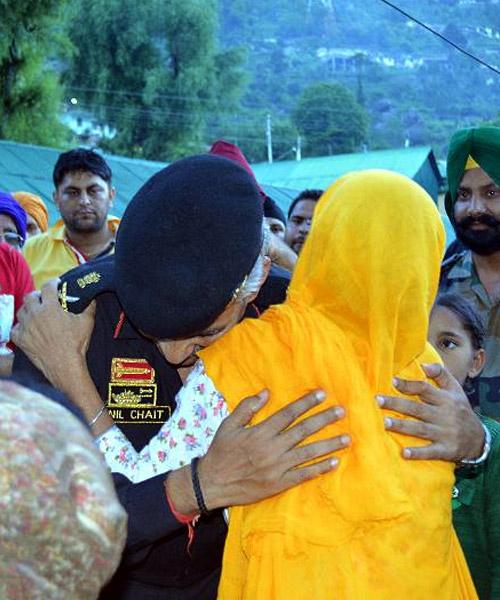
They needed a shoulder and a few words of consolation.
They needed a blanket of hope and warmth, the hug of a relation. A relationship of being a fellow Indian.
Prev

Next
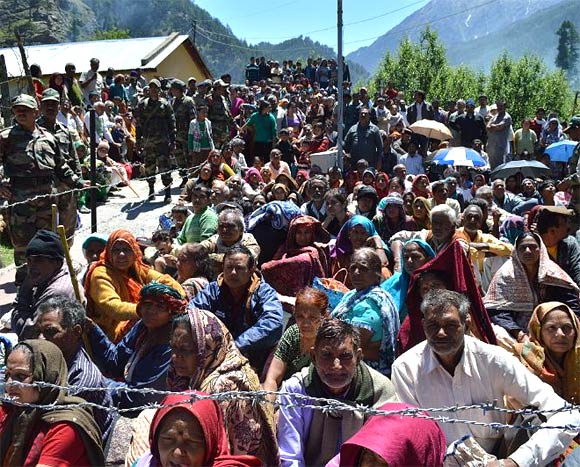
The people of Gupt Kashi did try to help them wonderfully. The city, a small buzzing town of pundits, ritual performers, shopkeepers of religious needs like dhoop, agarbattis, pooja samagri, lodge-owners of Kedarnath, helpers, guides, members of temple committee, employees of local government offices was enveloped in grief.
Almost every home in this region, particularly Gupt Kashi and Ukhimath, has lost someone in the family.
They were desperately scouring the lists getting updated every few hours to find if their relatives’ names were there. The town was closed down. No one had the courage to do business when the lights in their homes had died.
Still they were the young and the old of Gupt Kashi, who came out to help forlorn pilgrims. They began a free langar, started missing persons search centre, 24-hour announcements were made of the list of arrived pilgrims and missing names. Medicines were provided free. The RSS volunteers were as usual doing their bit. Providing food, blankets, shelter and guidance. They were the first to reach Gauri Kund, the point where the rescued pilgrims were brought from Jungle Chatti. Hungry, dejected, shocked with grief, fatigued and bewildered at being still alive after having spent six days amidst decaying corpses.
Everything was needed more and everything available was just not sufficient. The town never had the attention of governors sitting at the Dehradun secretariat. In spite of being the centre of gravity for all things happening at Kedarnath, the feeder city to pilgrimage for all purposes, it abysmally lacked in infrastructure. A very unreliable power supply, no solar alternative, no toilets, no city cleaning mechanism, and not even an iota of a disaster management centre.
The government camps for rescued pilgrims had no power supply. When I visited in the evening, candles were being provided to some. Imagine a people just arrived rescued from the jaws of death, and many of them had seen their father, mother, brother, sister, wife, husband dying before their eyes and they had to leave their dead bodies either unattended or had them immersed in the Mandakini without being able to even perform the last rites.
These were the people stationed in the clumsy, dark, and stable-like rooms without a proper toilet facility. A few toilets, in the school, were rendered useless due to paucity of water and non-functional flush. Fatigued and barely able to walk, pilgrims had to ease themselves in the open, on the outskirts of the camp, which was an Inter college building.
And the worst was not yet over. They couldn’t speak to their relatives on phone -- mobile phones were not working. BSNL was the only source of some hope, to bring cheer on the faces of their anxious relatives back home, but without power most couldn’t recharge their mobiles. Almost ninety nine percent had got their mobile phones soaked in rain water and besides, the other private mobile phone operators were simply mercilessly insensitive to the tragedy. ‘Happy to help’ meant a hoax call for all of us. They could have had a special arrangement to get the ‘tower’ activated, facilitating communications to the pilgrims. But no one came forward to help them in the hour they needed it most. The first thing, after having survived the unspeakable ordeal, a pilgrim would have liked to do is to speak to his near and dear ones. But we Indians, the companies we own -- Vodafone, Tata, Reliance – simply didn’t care.
Nilesh Bharane, the effervescent superintendent of police manning the Gupt Kashi helipad did try the satellite phone to get the Sonis of Gujarat to speak their Mumbai kin but ultimately had to go to a corner of the airfield where like voodoo magic, the signal, feeble though, came through and we saw the Sonis speaking to their folk through intermittent sobs. They had lost their father at Kedarnath.

More
Each yatri had to tell more than his and her story. Heaven it was once which has turned into a burial ground for the living. With all the advancements in technology, all that glib talk of disaster management, the towering Indian conquering the world with his brilliance and high-end acumen, the fact is we failed our people in crisis. Ultimately the armed forces had to be deployed, who emerged as the new gods.
With the instruments available, within the framework of the existing infrastructure and trained, untrained, manpower at hand, everyone did his best. If the RSS and BJP were there in the forefront of relief work, the Congress and many other organisations too worked at the ground level and I went to them, shook hands and appreciated their efforts unhesitatingly. They are Indians, and should we get into the murky blame game and one-upmanship because we do not belong to their ideology? That would be demeaning to our own noble intentions.
We must salute the spirit of service in everyone who went there and did his bit -- if the army, IAF are everyone’s heroes, the police, local employees, district magistrates and officers drawn from various departments tried to help. If the Gauri Kund hospital saw everybody gone to safety, there was one pathologist who refused to leave and nursed single-handedly the rescued yatris coming from Jungle Chatti area.
There are hundreds of such small stories of heroes who made a big difference. The IAF couple who flew sorties to bring back yatris, the Jha-Janamejay duo (DM and SP) in Tehri who got the crucial Mayala road opened to Gupt Kashi, which effectively became a lifeline to rescue work and outflow of yatris.
In times of any huge crisis, people naturally panic and need immediate help. It’s not possible sometimes. Still, I sincerely feel, with no offence to the heroes and every one of those who worked to help, we were lacking in an infrastructure that could have responded to such a situation rapidly. At the end of the day, everything depended on the army and IAF. It was the same in 1940, in 1960, in 1970 and so on.
There are lessons to be learnt. How not to politicise a relief operation, keep the communication channels on in the gravest of situations, have the disaster management team professionally stationed at every vulnerable place, regulate the inflow of yatris like Kailash and Amarnath Yatras, provide the best of infrastructure to these border areas visited by millions, train the civil servants to be polite and responsive to the common people, and a political leadership that loves to work and mingle with the masses.

Tarun Vijay returns from Gauri Kund with above mentioned grim account.

Tarun Vijay is member of Parliament, Rajya Sabha; member, Parliamentary Consultative Committee on the Ministry of External Affairs; member, Parliamentary Standing Committee on the Ministry of Human Resource Development; member, Parliamentary Group on India China Friendship; Hon Director, Dr Syama Prasad Mookerjee Research Foundation.


Tuesday, June 11, 2013

TIPS - HOW TO DRAFT A WILL FOR YOUR ONLY DAUGHTER?


TIPS - HOW TO DRAFT A WILL FOR YOUR ONLY DAUGHTER?

Succession & Wills

What is Estate? 

Estate consists of various assets like immovable properties: House, factory, shop, office, farm, etc. and movable properties: jewellery, paintings, cash & bank balances, bullion, shares, mutual funds, insurance policies, recurring & fixed deposits etc. 

What is estate planning?

Estate planning is a systematic continuous process to control and mange assets fulfilling various familial, social & spiritual obligations while protecting the assets from creditors and optimising various costs.
Estate planning has varied objectives:
• Person wants to retain control and management of his assets during his life
   time and also after his death. 

• He wants to transmit his assets amongst the family members whether existing
  or non-existing.
• He wants to protect his property from the creditors.
• All this is done at an optimised cost. Costs can be taxes, stamp duty, etc. 

Estate planning is for whom?

It is generally thought that estate planning is required only for the HNI or wealthily person. Middle class families who are barely hand to mouth is not required to do any estate planning. It’s a myth. In fact, every person irrespective of economic standing, age, marital status is required to plan for his estate. 

Estate Planning devises

Estate planning can be devised using one or more of following:
a) Will
b) Trusts private or public charitable
c) Mutual Wills
d) Joint ownership, tenancy in common
e) Transfers during lifetime
At times each of the above devises is used in the complex structure. Complexity further added depending upon the place of situation of the property and applicability of personal laws. 

Succession

The rights and obligations of the deceased person get transferred to the living person under the process of succession. They pass to some person, whom the dead person or the law on his behalf, has appointed to represent him in the world of living.
Succession depends on:-
(a) The law applicable to the deceased at the time of his/her death
(b) The machinery of succession, whether
(i) Testamentary under Will of the deceased, or
(ii) Intestate in the absence of valid Will, or
(iii) Operation of law, by nomination, transmission,
(c) The nature of property or rights and obligations held by the deceased at the
     time of death.

Movable property 

Succession of the movable property in India of a deceased person is regulated by the law of country in which such person had his domicile at the time of his death. If a person dies leaving movable property in India in absence of proof of any domicile elsewhere, law in India regulates succession of his movable property.

Immovable property

The laws of India regulate succession of the immovable property situated in India, wherever such deceased person may have/had his domicile at the time of death.
Laws governing the succession of the deceased person at the time of death are dependent upon the nature of persons, which are as under:
(a) Hindu Succession Act, 1956 and some provisions of Indian Succession Act mainly govern Hindus, Buddhist, Sikh and Jains.
(b) Mohammedans are mainly governed by their Personal Law.
(c) Indian Succession Act, 1925 is applicable to others; i.e., Christians, Jews, Parsis (as applicable to Parsis) and the person whose marriage is solemnised under Special Marriage Act, 1954 (including their issues).
However if both the spouses are Hindus, Buddhist, Sikh and Jains even though their marriage is solemnised under Special Marriage Act, 1954 shall be governed by Hindu Succession Act. It may be noted that these provisions shall apply only to the person whose marriage is solemnised under Chapter II of the Special Marriage Act and not to the spouses who are already married and thereafter get their marriage registered under Chapter III of the Special Marriage Act.
Hindu Succession Act makes a distinction between Male & Female for deciding the manner of distribution of their estates. Heirs are defined as Class I, Class II, Agnates and Cognates for the Hindu male. Devolution of the property of Hindu male dying intestate is governed by section 8 and that of distribution of property of Hindu female dying intestate is governed by the Sections 15 & 16 of the Hindu Succession Act, 1956.
Property of the Hindu male devolves upon his widow/s, children (including heirs of a predeceased child through such child) and mother in equal share (Class I). In case none of them are present, the property Will pass to Class II heirs. Class II heirs are divided into nine categories consisting of father if he is alive and failing which to his son’s/daughter’s children, brother, sister and other relative specified in schedule. In case none of Class II heirs are present then the property shall devolve to agnates (person is said to be agnate of another if the two are related by blood or adoption wholly through males) and then to cognates (person is said to be cognate of the another if the two are related by blood or adoption but not wholly through males). Brothers & sisters under Class II shall not include brother/sister by uterine blood. However in absence of Class I heirs’ uterine brother is entitled to succeed to the estate of deceased bachelor.
Illegitimate children cannot be included within the meaning of the words sons & daughters as used in the list of Class I heirs. When a man marries second time during lifetime of his first wife, children from both wives would be entitled to share the retiral benefits after his death. The second marriage being void, his second wife would not be entitled to the retiral and pensionary benefits. The first wife would be entitled to gratuity, provident fund, family pension and other benefits. With the deletion of section 24 remarried women (widow of predeceased son, widow of predeceased son of a predeceased son) can succeed to the estate of Hindu dying intestate. A Hindu who has converted himself to Muslim is not entitled to inherit the property of a Hindu under Hindu Succession Act. A step-mother is not entitled to get property of her son or her daughter; however she can be an heir as father’s widow under Entry VI of Class II.
When a Hindu dies, after the commencement of the Hindu Succession (Amendment) Act, 2005 his interest in the joint family properties governed by the Mitakshara law, shall devolve by testamentary or intestate succession and not by survivorship. The interest of a Hindu Mitakshara coparcener shall deemed to be share in the property that would have been allotted to him if a partition of the property had taken place immediately before his death, whether or not he was entitled to claim partition.
• Further his coparcenary/joint property shall be deemed to have been as if partition had taken place.
• The daughter is allotted the same share (assets/liability) as is allotted to a son.
• The child of the predeceased son/daughter or grandchild of the pre deceased son/daughter shall be entitled for the share of predeceased son/daughter.
Whereas property of Hindu female shall devolve upon her husband and children (including heirs of a predeceased child through such child) in equal share. In case none of them are present, property Will pass to the heirs of her husband and failing which to her mother and father and later on to the heirs of the father and lastly to the heirs of mother. However any property inherited by female Hindu from her father/mother shall, in absence of her children (including grand children) devolve upon heirs of father and any property inherited from her husband or her father in law shall, in absence of her children (including grand children) devolve upon heirs of the husband.
Husband Will not be entitled to succeed to the property left by his wife, if she has acquired the said property from her father. Accordingly issueless female Hindu’s property (property acquired from her father/mother) shall devolve on the heirs of her father. However property earned by a woman exclusively is Stridhan and Will devolve upon her heirs. In other words where property was inherited by a lady from her parent(s), it shall not pass to her husband or to her husband’s heir where she dies without children or children of predeceased children. Any property possessed by a female Hindu shall be held by her as full owner thereof and not as a limited owner (Sec. 14). Illegitimate daughter cannot claim heirship as per section 15 of the Act. Further ‘step son’ and ‘step daughter’ are not included in the term ‘son’ or ‘daughter’ in section 15(1) and accordingly are not entitled to share in property.
By the 2005 Amendment Act, four categories of heirs which were hitherto placed in Class II were elevated to Class I heirs namely (i) Daughter’s son’s son, (ii) Daughter’s daughter’s daughter; (iii) Daughter’s son’s daughter; and (iv) Son’s daughter’s daughter. While adding these categories to Class I, the corresponding entries in Class II were not deleted. Thus there is overlapping between Class I and Class II schedule.
The Law Commission of India in its 204th Report on the Hindu Succession Act, 1956 has suggested to the Government that that father should be placed along with mother in Class I and both together should take one share. The Commission has also suggested revision of Class I heirs as in the opinion of the Commission, Class I heirs list in the Schedule is complex and cumbersome and is not amenable to easy understanding.

Person dying intestate

If person dies without making a ‘Will’, he is said to have died intestate and in such case his property Will be inherited by his heirs in accordance with law of succession as discussed above and in case a person dies leaving behind Will his property shall be distributed as per the terms of ‘Will’ which is known as Testamentary Succession. In other words Testamentary Succession means succession to a property of the deceased in accordance with the provisions in the last Will and Codicil of the deceased.
A Mohammedan can, by ‘Will’, dispose of not more than 1/3rd of his estate after payments of debts and balance 2/3rd of property devolves according to the applicable Shariat Law. However testator may bequest more than 1/3rd of his property provided heirs consent to such bequest only AFTER Testators death. If the testator has no heirs, he may bequest the whole of his property to stranger. In matters of Succession and inheritance, Hindu Law governs a Khoja.
‘Will’ means a legal declaration of the intention of a testator with respect to his property, which he desires to be carried into effect after his death - Section 2(h) of Indian Succession Act, 1925. ‘Will’ as including Codicil and every writing making a voluntary posthumous disposition of property - Section 3(64) of General Clauses Act, 1987.
‘Codicil’ means an instrument made in relation to Will and explaining, altering or adding to its dispositions and is deemed to form part of the Will - Section 2(d) of Indian Succession Act, 1925.
Essential Characteristics of Will are:
(a) The document must be in accordance with the requirements laid down under section 63 of Indian Succession Act, 1925; i.e., executed by a person competent to make Will and attested as required under the Act.
(b) The declaration should relate to the properties of the testator, which he wishes to bequeath.
(c) The declaration must be to the effect that it operates after the death of Testator and is revocable during his life time.
(d) After the Indian Succession Act, 1925, Wills (except made by Mohammedans) should be made in writing. 

Types of Wills

Under the Indian Succession Act, Will can be Privileged Will or Unprivileged Will.

Privileged Will 

Any soldier being employed in an expedition or engaged in actual warfare, or an airman so employed or engaged, or any mariner being at sea, may, if he has completed the age of eighteen years, dispose of his property by a Wills made in the manner provided in Section 66. Such Wills are called privileged Wills. Privileged Wills may be made orally and may not always be in writing. If written in handwriting of testator, it may not be signed or attested. It is governed by sections 65 & 66.

Unprivileged Will 

Wills made by the persons other than stated above are Unprivileged Will. Such Wills are required to be in writing, signed by testator and attested by the two witnesses (except those made by Mohammedans). It is governed by section 63.

Will can be made by

Every person of sound mind, not being minor may dispose of his property by Will. As a general rule, until, the contrary is established, a testator is presumed to be sane and to have a mental capacity to make valid Will. However no person can make Will while he is in a state of mind arising from intoxication or from illness or from any other cause such that he does not know what he is doing - (Sec. 59 Indian Succession Act). Even persons who are deaf or dumb or blind can make Will provided they are aware what they do. Further person who is ordinarily insane, may make his Will during the interval in which he is of sound mind.

Essential clauses of Will

1. Name: The name and description like age, religion, community etc. of the testator.
2. Revocation of earlier Wills: A declaration that the present Will is his last Will and testament and that he revokes all other earlier Wills, codicils.
3. Appointment of Executors: An executor is a person named by the testator in the Will to whom the testator has confided the execution of Will. If legacy or bequest is given to executor it should be mentioned in the Will that he would be entitled to legacy even if he does not accept to act as the executor of the Will unless there is any contrary intention.
4. Direction to pay dues if any
5. Legacies and Bequest: This is important clause in the Will, because under these clauses the testator makes the disposition of his property. He can make requests to future person also.
6. Residue clause: It is always advisable to have Residue Clause disposing of the residue (i.e., remaining property belonging to the testator at the time of the death which is not specifically disposed) of the testator’s property. If there is no residue clause such remaining property Will go to the legal heir of the testator. Even the legacy which lapse go back to intestacy if there is no residue clause.
7. Testimonium Clause: The testimonium clause is as "in witness whereOF I said _______ have hereunto set and subscribed my hand at ______ on this __ day of ______ 20__."
8. Execution Clause: This is the last clause of the Will which begins with "Signed and acknowledged by the within named Testator as his last Will and Testament". The Testator should sign the execution clause in the presence of two witnesses who should also subscribe their signatures as witness in the presence of the Testator. The witness and/or his spouse cannot be made beneficiary under the Will as any bequest in their favour would be void. However validity of the Will and all other bequests made under it continue to remain valid. In such a case the indisposed portion of the bequeathed property shall devolve as per the law of inheritance. These provisions are not applicable to Hindu, Sikh, Jain or Buddhist. It is preferable to have a doctor to certify that testator is of sound mind and under no influence of alcohol when he made the Will.

Other Important points

1. Preparation of a Will does not require any specific legal language.
2. Will need not be stamped.
3. Registration of Will is not mandatory. However a registered Will has certain advantages.
4. A Will can be revoked at any time by the testator during his life time.
5. A Will stands revoked by marriage of the maker Sec. 69. However this rule does not apply to Hindus, Buddhists, Sikhs, Jains or Mohammedans Sec. 57.
6. Either the Hindu Succession Act or the Indian Succession Act does not put any embargo on the power and authority of the executants that a Will cannot be executed in the favour of a person who is professing another religion.
7. It is important to note that the attesting witnesses need not know the content of the Will.
8. No alternation made in a Will after the execution shall have any effect, unless such alternation has been executed in the same manner as a Will and attested by two attesting witnesses Sec. 71.
9. In respect to construction of Wills, the law is well settled that intention of the testator has to be ascertained from the words used in the Will, keeping in view the surrounding circumstances, the position of the testator and his family relationship and that the Will must be read as whole.
10. No man having a nephew or niece or any nearer relative shall have power to bequeath any property to religious or charitable uses, except by a Will executed not less than twelve months before his death, and deposited within six months from its execution in some place provided by law for the safe custody of the Wills of living persons. However it is not applicable to Hindus, Buddhists, Sikhs, Jains & Parsis.
11. Any testator may, either personally or by duly authorized agent deposit with any Registrar his Will in a sealed cover superscribed with the name of the testator and that of his agent (if any) and with a statement of the nature of the document as per Section 42 of Registration Act, 1908.
12. The testator, or after his death any person claiming as executor or otherwise under a Will, may present it to any Registrar or Sub-Registrar for registration under section 40.

Probate 

Probate is a certificate granted under the seal of Competent Court, certifying the Will (a copy whereof is annexure thereto) as the Will of the testator and granting the administration of the estate of the deceased in accordance with that Will to the executor named under the Will. No right as executor or legatee can be established in any Court of justice, unless a court of competent jurisdiction has granted probate of the Will under which the right is claimed, or has granted letters or administration with the Will or with the copy of an authenticated copy of the Will annexed.
As per Section 213 of Indian Succession Act, Probate is not necessary in the case of WillS made by Mohammadans, However probate is necessary:
(a) To all Wills codicils made by any Hindu, Buddhist, Sikh or Jain, on or after 1-9-1870, within the territories of the Lieutenant-Governor of Bengal or within the local limits of the ordinary original civil jurisdiction of the High Courts of Judicature at Madras and Bombay (Section 57);
(b) To all such Wills and codicils made outside those territories and limits so far as they relate to immovable property situate within those territories or limits (Section 57);
(c) In the case of Wills made by any Parsi dying, after the commencement of Indian Succession (Amendment) Act, 1962, where such Wills are made within the local limits of the ordinary original civil Jurisdiction of the High Courts at Calcutta, Madras and Bombay, and where such Wills are made outside those limits, in respect of immovable property situated within those limits.
(d) Wills of Christians dying after 27-5-2002 made within the territories mentioned in (a) above.

Letters of Administration

A letter of administration can be obtained from the Court of competent jurisdiction in cases where the testator has failed to appoint an executor under a Will or where the executor appointed under a Will refuses to act or where he has died before or after proving the Will but before administration of the estate. Letters of Administration are not always necessary in cases of intestacy of Hindus, Mohammedans, Buddhists, Sikhs, Jains, Indian Christians or Parsis. Letter of Administration are always necessary where a person (governed by the Indian Succession Act) dies intestate.

Succession Certificate

In case, where grant of Probate or Letters of Administration is not compulsory, Succession Certificate can be granted by the Court with respect to any ‘debt’ or ‘security’ to which a right is required to be established by Letters of Administration or Probate and for this purpose ‘security’ means Government Securities, shares, stocks and debentures in companies and incorporated institutions, debentures or securities issued by or on behalf of local authorities and any other security which the State Government may notify.

Court fees on application of Probate and Letters of Administration

Court fees payable in Maharashtra in the slab manner  as under:

Value of property in the application and Rate

Value of property in the application
Rate
Up to Rs. 50,000
2%
Between Rs. 50,001 & Rs. 200,000
4%
Between Rs. 200,001 & Rs. 300,000
6%
Above Rs. 300,001
7.5% but restricted to Rs.75,000
A maximum Court fees payable in the State of Maharashtra is Rs. 75,000 for obtaining a probate. No court fees was payable in case the Will is administered by the Woman Executor; i.e., executrix up to 23-3-2000. Court fees are payable only in respect of such assets of the estate as were at the time of death of the testator locally within the jurisdiction of the authority which grant probate.

Will vis-à-vis Nomination

The nomination continues only till the Will is executed. Once the Will is executed, the Will takes precedence over the nomination. Nomination does not confer any permanent right upon the nominee, nor does it create any legal right in his favour. In other words generally nominee is for all purposes a trustee for the property. However the provisions of law, under which nomination is made need to considered carefully to understand whether nomination would prevail or not.

Conclusion 

In order to achieve your objective and have a happy ending best time to start planning as soon as possible. It’s better to act now, since life is full of uncertainties and no one has a second chance. Furthermore, in absence of social benefits in India, estate planning is important. Role of advisors is crucial who can guide to achieve objective considering the applicable laws with optimised costs.
Posted in the Blog on June 11, 2013